Your cat has a secret life. Some of it happens three gardens over. Some of it happens under the guest bed at 3 a.m. Wearable tech for cats gives you a window into both: where your cat roams, how much they move, and when their routine quietly starts to change.
The gear has come a long way. Today’s smart collars weigh less than an ounce, and the newest ones log heart and breathing rates on top of live GPS.

Do Cats Need a Lot of Tech?
Most cats do best with a microchip plus a breakaway ID collar. Add a GPS tracker if your cat goes outdoors, and an activity monitor if your cat is a senior or has joint or weight issues.
What Counts as Wearable Tech for Cats?
Cat wearables fall into five groups. Most clip onto or come built into a collar, and a few work alongside the microchip your cat may already have.
- GPS trackers use satellites and a mobile network to show your cat’s live location on your phone, from almost anywhere.
- Bluetooth tags are small, cheap fobs that report a location when they pass near a phone on the same network.
- Activity and health monitors use motion sensors to count active minutes, rest and sleep. Some newer models add heart and breathing rates.
- RFID collar tags and microchip-reading gadgets open smart cat flaps and feeders for your cat and nobody else.
- Safety collars with reflective strips or LED lights make your cat easier for drivers to spot at night.
Many products mix these up. A single GPS collar might also track activity, flash an LED and send you an alert when your cat leaves the yard.
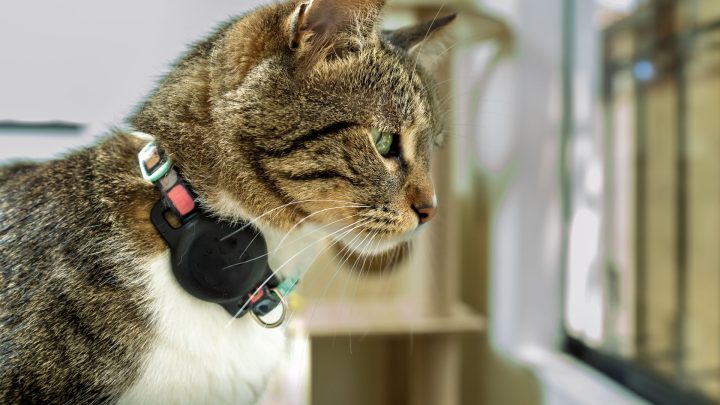
GPS Trackers vs. Bluetooth Tags vs. Microchips
These three get mixed up all the time, and they solve different problems. A GPS tracker finds your cat right now. A Bluetooth tag helps you find a cat hiding close by. A microchip proves who your cat belongs to once someone scans it.
| Feature | GPS tracker | Bluetooth tag (e.g. AirTag) | Microchip |
|---|---|---|---|
| How it locates your cat | Satellites plus a mobile network | Nearby phones on the same network | A scanner at a vet clinic or shelter |
| Range | Anywhere with cell coverage | About 30 to 40 ft from your own phone, then depends on strangers’ phones | A scanner held close to your cat |
| Live tracking | Yes | No | No |
| Ongoing cost | Monthly or yearly subscription | None beyond batteries | Keep your registry details current |
| Power | Rechargeable, days to weeks | Coin battery, months | None needed |
| Best for | Cats who go outdoors | Indoor cats who might slip out and hide nearby | Every cat, as permanent ID |
Why the microchip still matters
Even the best tracker can fall off or run flat. A microchip can’t. In an Ohio State study of microchipped shelter animals, microchipped cats went home to their owners 20 times more often than stray cats overall.
The catch is paperwork. In the same research, the most common reason a chipped pet couldn’t go home was a wrong or disconnected phone number in the database. Moved recently or changed numbers? Update your registry today.
What about an AirTag on a cat collar?
Bluetooth tags are tempting because there’s no subscription. They have real limits, though. Once your cat leaves your phone’s Bluetooth range of roughly 30 to 40 feet, the tag only updates when a stranger’s phone passes by. You won’t get a live trail, and a cat holed up in a quiet shed may not ping at all.
There’s also a safety angle. Small round tags can dangle and get chewed, and a swallowed tag may need surgery to remove. If you use one, choose a holder that sits flat against a breakaway collar.

Health and Activity Monitors (What They Track)
Cats are masters at hiding pain, which makes health tracking one of the most useful jobs a wearable can do. A motion sensor notices that your cat jumped 30% less this month long before you would.
Arthritis is a good example. Feline specialists estimate that about 60% of cats over 6 and 90% of cats over 12 show X-ray signs of arthritis, yet the condition often goes undiagnosed. The early signs are small: fewer jumps, shorter play sessions, more naps.
What the sensors measure, and what changes can hint at
| What the device tracks | A change worth noticing | What it might point to |
|---|---|---|
| Active minutes per day | A steady drop over a week or more | Joint pain, illness, weight gain |
| Sleep and rest | Restless nights or much more sleep | Discomfort, stress, age-related changes |
| Heart and breathing rate (newer models) | A rise in resting rate | Something your vet should check |
| Calories burned | Lower output with the same food | Weight creeping up |
Does the science back it up?
Vets have used collar-mounted motion sensors in research for years. A 2025 review of activity monitors in companion animal pain research found they give objective data that can help with diagnosis and with judging how well a treatment works.
Consumer gear is joining in. A 2020 study of a cat-specific activity monitor found it could measure activity and sleep quality accurately. And a 2024 veterinary pilot study used an off-the-shelf GPS collar to log daily active minutes in seven cats with arthritis while they were treated for pain.
One honest caveat: a smart collar can’t diagnose anything. Treat its data as a conversation starter with your vet. Trends over weeks matter more than one lazy Sunday.
Smart Cat Flaps, Feeders, and ID Tags
Some of the handiest cat tech never sits on your cat at all. It reads the microchip already under their skin.
- Microchip cat flaps unlock only for registered cats, so the neighborhood bully stays outside. The SureFlap Microchip Cat Flap works with common pet microchips and with an RFID collar tag for cats without a chip.
- Microchip feeders open the bowl for one cat only. They’re a lifesaver in homes where one cat is on a prescription diet and the other is a food thief.
- Connected versions send a phone alert when your cat comes or goes, which gives you a simple in-and-out log with no collar needed.
Don’t skip the humble ID tag
A name tag with your phone number is the fastest way for a neighbor to reach you. It needs no scanner, no app and no battery. And indoor cats need one too: research led by Ohio State found that 40% of lost cats in one community were indoor-only cats.
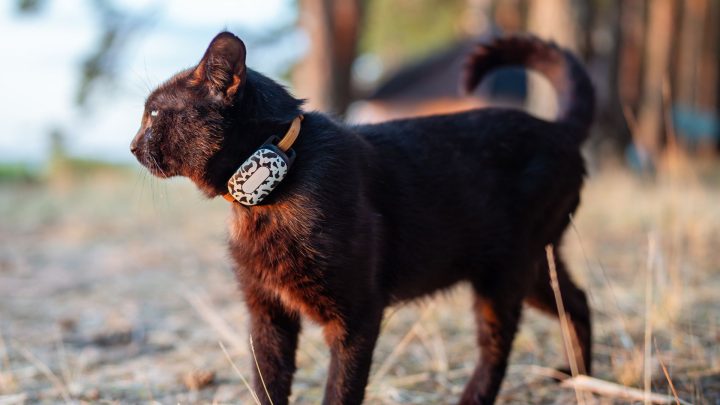
Safety First: Collars, Weight, and Fit
A tracker is only as safe as the collar holding it. Get these four things right and most cats wear tech without fuss.
- Use a breakaway collar. A quick-release clasp pops open if the collar snags on a fence or branch. The RSPCA recommends a breakaway clip with an ID tag, and UK emergency vets warn about injuries from poorly fitted or non-breakaway collars.
- Fit it with the two-finger rule. You should slide two fingers between collar and neck. Too loose and a paw or jaw can slip through. Too tight and it rubs.
- Check the weight. The Tractive CAT Mini, for example, weighs 25 g on its own and 42 g with its collar, and the maker lists it for cats over 7 lb (about 3 kg). Kittens and petite cats may need to wait.
- Watch the first few days. Most collar trouble shows up early, while your cat is still adjusting.
Will my cat actually wear it?
Probably! In a multi-university study of 538 cats, almost three in four kept their collar on for the full six months, and close to 60% of owners said their cat coped better than they expected.
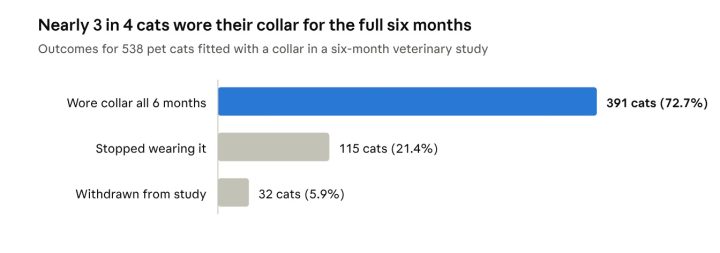
Problems were uncommon: in the same study, collars getting caught in a cat’s mouth or on an object affected about 1.5% of cats. That’s low, and a breakaway clasp lowers the stakes further.
How to Choose the Right Wearable for Your Cat
Start with your cat’s lifestyle, then work out the budget. A homebody and a fence-hopping hunter need very different gear.
Match the tech to your cat
| Your cat | Best starting setup | Pourquoi |
|---|---|---|
| Indoor-only homebody | Microchip + breakaway ID collar | Covers the surprise escape without a monthly bill |
| Indoor-outdoor explorer | Microchip + GPS tracker on a breakaway collar | Outdoor cats roam much farther, so live location pays off |
| Senior or arthritic cat | Activity monitor (many GPS collars include one) | Flags slow changes in movement and sleep |
| Multi-cat household | Microchip cat flap or feeder | Controls who comes in and who eats what |
That roaming gap is real. In a study of 1,210 lost cats, 75% of cats with outdoor access were found within about 1,600 m (1 mile) of home, compared with about 140 m (roughly 450 ft) for indoor-only cats.
Your buying checklist
- Weight limit: Check the device against your cat’s weight. Lighter is kinder.
- Breakaway clasp: Built in, or paired with a quick-release collar.
- Battery life: Days for most GPS trackers, months for Bluetooth tags. Pick something you’ll actually remember to charge.
- Subscription and coverage: GPS trackers need a mobile signal. Check the maker’s coverage map for your area.
- Water resistance: Rain and the odd water bowl dunk happen.
- App features: Virtual fence alerts, location history and health trends are the ones people use most.
- Trial or refund window: Your cat gets a vote, so make sure you can send it back.
What it costs
| Device | Upfront | Ongoing |
|---|---|---|
| GPS tracker (Tractive CAT Mini as an example) | $49 | Subscription, from about $5 to $13 a month depending on the plan |
| Bluetooth tag (Apple AirTag) | About $29 | A coin battery now and then |
| Microchip cat flap (SureFlap) | About £100 in the UK | Batteries |
Prices checked in November 2026 and change often, so confirm before you buy.
Getting Your Cat Used to Wearing Tech
Most cats accept a collar within a few days if you go slow and bring snacks. Here’s a simple routine.
- Let them sniff it first. Leave the collar and device near their bed or food bowl for a day or two so it smells familiar.
- Start with the collar alone. Put on the empty breakaway collar for short sessions, paired with treats or play.
- Add the device once the collar is old news. Clip it on during a calm moment, then distract with a favorite toy.
- Stretch the time gradually. Go from minutes to hours to all day over about a week.
- Check the fit daily at first. Two fingers underneath, no rubbing, no fur loss.
- Set up the app before the first outdoor trip. Mark a home zone and test that alerts reach your phone.
A bit of scratching at the collar on day one is normal. If your cat still seems stressed after a week, or you see sore skin, take it off and check with your vet.
FAQs About Wearable Tech for Cats
Yes, when the tracker is light enough for your cat and sits on a breakaway collar that fits with the two-finger rule. Check the maker’s minimum weight, watch your cat closely for the first few days, and look at the skin under the collar now and then.
You can, but it works best for indoor cats who might hide close to home. AirTags have no live tracking and rely on passing phones once your cat is out of range. Use a holder that lies flat against a breakaway collar so it can’t be chewed or swallowed.
Almost all of them do. The fee pays for the built-in SIM card and mobile data that let the tracker report from anywhere. Expect roughly $5 to $13 a month, with cheaper rates on yearly or two-year plans.
Most GPS cat trackers run for about 5 to 7 days per charge, longer if you use a home Wi-Fi or power saving zone. Live tracking mode drains the battery fastest. Bluetooth tags run for months on a coin battery.
It can’t diagnose illness, but it can spot changes worth a vet visit. A steady drop in activity, restless sleep or a higher resting heart or breathing rate are all good reasons to book a checkup and bring the data along.
Indoor cats do get lost, usually through an open door or window. A microchip plus a breakaway ID collar is the minimum. A tracker is a nice extra for escape artists, new homes or cats who live near busy roads.
No. A collar can come off, and a battery can die. A microchip is permanent ID that any vet or shelter can scan. Use both, and keep your microchip registry details current.
Many cat trackers are made for adult cats over about 7 lb (3 kg). Kittens and very small adults are usually better off with a lightweight breakaway ID collar until they grow.





 English (United States)
 English (UK)
 German
 Italian
 Spanish
 French