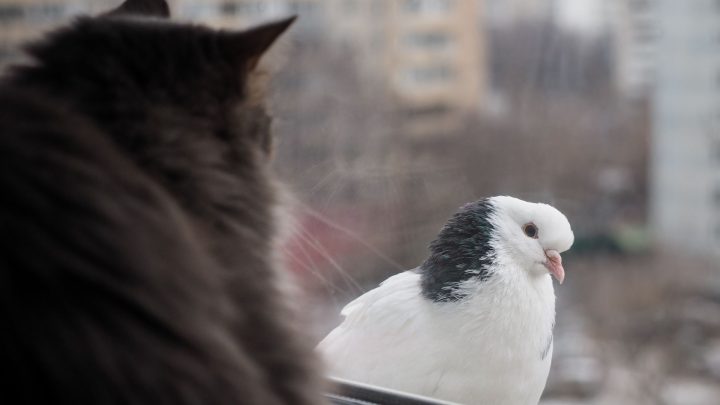
Your cat is parked on the windowsill, tail twitching, eyes locked on a sparrow. Then it happens: that weird, rapid-fire chattering sound that’s somewhere between a squeak and a machine gun. It’s not a meow. It’s not a purr. It’s its own strange little dialect, and once you hear it, you can’t unhear it.
So what’s actually going on in your cat’s head?
The Answer to the Chirps
Cats chirp and chatter at birds because their hunting instincts are firing on all cylinders and they can’t act on them. The sound is tied to prey drive, and researchers have floated a few overlapping explanations:
| Theory | What’s happening | How solid is the evidence |
|---|---|---|
| Excitement/arousal | The cat is overstimulated by the sight of prey | Widely reported by behaviorists, but not lab-tested |
| Frustration | The cat wants the bird but can’t reach it (thanks, window) | Common explanation, supported by the fact it’s rare outdoors |
| Killing-bite rehearsal | Jaw chatter mimics the neck bite used to kill prey | Anatomically plausible, based on how cats actually kill |
| Vocal mimicry to lure prey | The cat copies prey sounds to draw animals closer | Documented in wild cats (margays), not confirmed in house cats |
None of these theories cancel each other out. They probably all play a part, layered on top of each other depending on the cat, the situation, and honestly, the individual bird that’s testing its patience.
Chirping vs. Chattering: They’re Not the Same Sound
People use these words interchangeably, but cat behaviorists split them into two distinct noises:
- Chirping sounds closer to an actual bird call. Short, high-pitched, almost musical. Some researchers think this version leans toward mimicry.
- Chattering is the jaw-vibrating, teeth-clicking sound, like your cat’s mouth is trying to bite something that isn’t there yet.
A cat can do either one on its own, or slide between both in the same episode. If you watch closely, you’ll usually see the jaw open slightly and vibrate right as the chattering starts, which lines up with the killing-bite theory below.
Theory 1: Pure, Uncut Excitement
The most repeated explanation among vets and behaviorists is that chirping is basically prey-drive overload. Vicki Jo Harrison, president of The International Cat Association, explained to Newsweek that a cat’s excitement at the prospect of a hunt triggers the chirping, often paired with a swishing tail, and likened the sound to a child’s excited squeal when handed a gift.
Feline behavior consultant Marci Koski gave Chewy a similarly straightforward take: cats get genuinely thrilled at the sight of a potential meal, and that excited energy comes out as chattering.
This lines up with something most cat owners notice on their own: the chirping almost always comes with a locked stare, a low crouch, and a tail that’s either puffed up or twitching like it has its own heartbeat. That’s not a relaxed cat. That’s a cat whose entire nervous system just switched into hunt mode.
Theory 2: Frustration at the Glass
Here’s a detail that makes this theory hold up: cats rarely chirp when they’re actually stalking prey outdoors. Silence is the whole point of a real hunt. Too much noise and the bird bolts before the cat gets close.
So why the racket at the window? Because the glass removes the need for stealth and replaces it with something cats handle a lot worse: an unreachable goal. According to Cats Protection’s behavior team, chattering may be tied to a rush of adrenaline from seeing prey a cat can’t reach, and cats that actually have a real shot at hunting tend to stay as quiet as possible so they don’t scare the prey off. Indoor-only cats, unsurprisingly, chirp far more often than cats with regular outdoor access, since window-watching is often the closest they get to a real hunt.
Theory 3: A Rehearsal for the Killing Bite
This one’s a little darker, but it makes anatomical sense. When a cat actually catches prey, it finishes the job with a fast bite to the back of the neck, using jaw vibrations to help sever the spinal cord as quickly as possible so the prey doesn’t have a chance to fight back or injure the cat.
Some researchers think the chattering is that exact motion running on a loop, minus the prey. Your cat’s brain is basically pre-loading the kill shot. Author Pam Johnson-Bennett, of Cat Behavior Associates, describes it as a kind of built-in control valve, where chattering is how a cat manages its own arousal at the sight of potential prey, almost like it’s keeping the moment to itself before making a move.
Theory 4: They’re Trying to Trick the Bird
This is the theory that turns “weird window noise” into genuinely fascinating animal behavior. In 2005, researchers in the Brazilian Amazon watched a wild margay, a small, spotted cat native to Central and South America, do something no one had documented before in that part of the world.
A group of eight pied tamarin monkeys was feeding in a tree when the margay began making calls that closely matched the distress sounds of tamarin infants. The lookout monkey climbed down to investigate instead of raising the alarm, and four more tamarins followed before the group realized what was happening and fled. As the Wildlife Conservation Society’s release on the study explains, the sighting confirmed what had previously only been anecdotal reports from people living in the Amazon, who described wild cats such as jaguars and pumas mimicking primates and other prey animals to lure them within striking range. WCS researcher Fabio Rohe summed up the significance well, noting that this kind of vocal manipulation of prey points to a level of psychological cunning that deserves more research. The full study, Calleia, Rohe & Gordo (2009), Hunting Strategy of the Margay to Attract the Wild Pied Tamarin, was published in Neotropical Primates.
Nobody has proven that housecats do the same deliberate trick on birds outside your window. But domestic cats share a huge amount of hunting behavior with their wild relatives, so it’s not exactly a stretch to think that some of your cat’s chirping might be an inherited echo of the same strategy, even if your cat has never had to hunt for a single meal in its life.
Is It Worth Attention?
Honestly, yes, but not because it’s mysterious or alarming. It’s worth paying attention to because it tells you something real and useful about your cat: this behavior is a window into unmet hunting instinct, and that’s information you can actually act on.
A chirping cat isn’t broken, sick, or angry. It’s a completely normal, healthy predator reacting to a completely normal trigger. The sound reveals that even the laziest, most spoiled housecat is still running on wiring built for hunting, and that instinct needs somewhere to go besides a windowsill.
Where it’s genuinely worth caring is here: if chirping is your cat’s only outlet for prey drive, that pent-up energy tends to leak out elsewhere, like pouncing on your ankles, shredding furniture, or 5 a.m. zoomies. So the behavior itself is fine to enjoy, but it’s also a decent early signal that your cat wants (and needs) more structured ways to hunt.
What You Can Actually Do About It
You don’t need to stop the chirping, and honestly, most owners find it entertaining. But if you want to give that hunting drive a healthy outlet, these are simple, doable changes:
- Add daily interactive play. Wand toys, feather teasers, or anything that mimics erratic prey movement for 10 to 15 minutes a day gives your cat an actual “kill” to complete, which helps burn off the same energy behind the chattering.
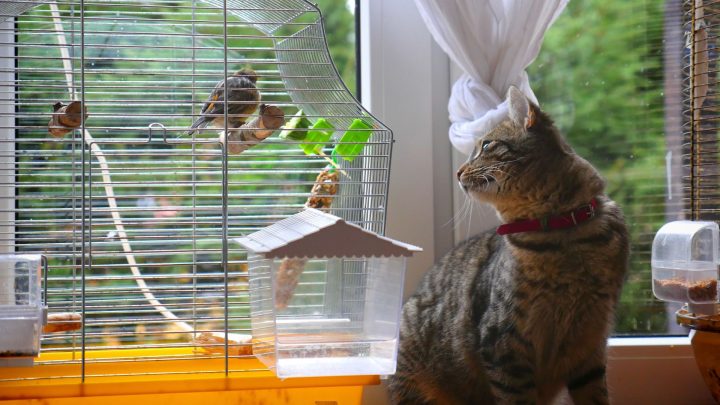
- Set up a proper window perch. If your cat is going to watch birds anyway, give it a comfortable, stable spot to do it from. Bird feeders placed outside a favorite window turn the frustration-inducing view into enrichment instead.
- Rotate puzzle feeders. Making your cat “hunt” for part of its food, even just kibble hidden in a treat maze, satisfies some of the same drive that’s building up during chirping sessions.
- End play sessions with a real “catch.” Let your cat physically catch the toy at the end of playtime instead of yanking it away. Finishing the hunt matters more than people realize for a predator’s mental state.
- Don’t punish or interrupt the chirping. It’s not aggression toward you, and there’s nothing to correct. Trying to stop it just removes a harmless outlet without solving the underlying instinct.
Cat chirping at birds is a mashup of excitement, frustration, and deep-seated predator instinct, possibly with a pinch of inherited trickery passed down from wild ancestors like the margay. It’s not something to worry about, and it’s not a sign your cat is stressed out or unwell. If anything, it’s one of the more honest windows you get into what your cat is actually thinking: I want that. I can’t have it. Let me tell you all about it.
Give that instinct a legitimate outlet through play and enrichment, and the windowsill chattering turns from a mystery noise into one of the more charming things about living with a small, indoor predator.
preguntas frecuentes
Yes. Cats with a window view of birds, squirrels, or feeders often chirp multiple times a day, especially during peak bird activity in the morning and evening. Daily chirping on its own isn’t a red flag.
Not usually. It’s more accurate to call it excited or frustrated arousal rather than stress in the anxiety sense. If it’s paired with other signs like loss of appetite, hiding, or aggression toward you or other pets, that’s worth a vet visit, but chirping by itself is a normal predatory response.
Real, moving prey outside the window taps into instincts that a felt mouse on a string doesn’t always trigger the same way. Toys can absolutely get a chirp too, especially ones with feathers or erratic movement, but birds hit every trigger at once: motion, sound, and size.
Kittens can chirp as young as a few weeks old, often while watching littermates play or stalking small objects. It’s an instinctive behavior, not something they learn with age.
That’s a personal call with real tradeoffs. Outdoor access reduces window frustration, but it also raises the risk of injury, disease, and harm to local bird populations. Supervised outdoor time, a secure “catio,” or leash walks give a lot of the same benefit without the downsides of free roaming.
Chirping shows up across breeds and mixed-breed cats alike. Some individual cats are simply more vocal than others, but the behavior itself isn’t tied to any particular breed.





 English (United States)
  English (UK)
  German
  Italian
  Spanish
  French