Noticing the symptoms of ailments affecting your dog can be tricky, even if it’s something as simple as a fever. If your dog has a high temperature, it’s usually just because they’ve been active. There are a number of other symptoms you might notice, though, if your dog does have a fever. But what are those symptoms, and what would cause a dog to get a fever in the first place? Read on for the answers to both of these questions and more.

¿Qué causa que un perro tenga fiebre?
La mayoría de las fiebres en los perros son causadas por una respuesta inmune o inflamatoria. Cuando se trata de causas exactas, puede variar. Puede ser una infección, que puede ocurrir cuando un perro está expuesto a bacterias dañinas.
Hay una serie de infecciones que pueden provocar fiebre en los perros: infecciones del oído, viral infections, UTIs, diseases borne from ticks, or infections of the dog’s internal organs.
Otra causa podría ser neoplásico, que puede resultar en el crecimiento de tumores malignos o benignos. La fiebre es un síntoma común del cáncer, particularmente del linfoma o la leucemia.
It could also be an immune mediated cause, which refers to when the dog’s immune system has become compromised, which would lead to an immune response.
There are a number of things that can indicate that a dog has a fever. In a moment we’ll break these down in detail.
But first…
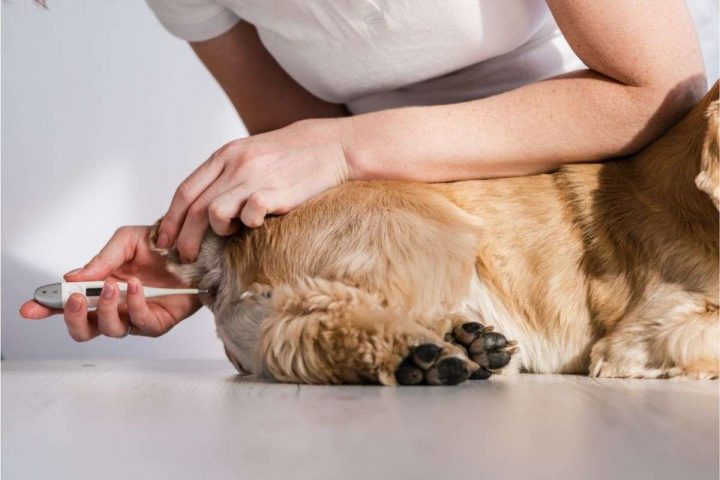
Conozca la temperatura normal de su perro
When you suspect that your dog has a fever, it’s going to be hard to make any conclusions from their temperature if you don’t know what their normal temperature is, when they’re healthy.
La temperatura normal puede variar según la raza, pero la temperatura promedio está entre 100,4 y 102,5 grados F.
Entonces, ¿cómo averiguas qué su dog’s normal temperature is? To do this, you’ll need to take their temperature with a rectal thermometer (when they’re feeling well, of course).

If you’d rather not, you can always just wait until your next routine checkup at the vet.
If you’re taking your dog’s temperature yourself, it’s important that you make sure they remain calm throughout the process. You can do this by feeding them treats throughout, or by having someone else gently hold them still.
- As we said, you’re going to need to use a rectal thermometer, so you must first make sure that it’s properly lubricated with lubrication gel or lubrication jelly.
- When you’re sure your dog is calm, lift up their tail gently (if it’s that kind of tail) and locate the rectum, which will be just under the dog’s tail.
- Inserte el termómetro lubricado hasta la punta recubierta de metal. En este punto puedes bajar la cola.
- Encienda su termómetro y espere entre 10 y 30 segundos, hasta que el termómetro muestre una lectura. Luego, retira con cuidado el termómetro y límpialo.
If you later suspect your dog of having a fever, you’ll be able to take their temperature in the same way, and compare this temperature to their normal temperature.
It’s worth noting that the temperature of your dog will vary throughout any given day. For example, they’ll tend to go up a little during the night.
It can also be beneficial to keep track of your dog’s normal respiratory rate, pulse, and capillary refill time. Having all this information on hand should make it easier to detect when your dog is unwell.
Cómo saber si tu perro tiene fiebre: síntomas
Alta temperatura
El temperatura que tiende a indicar fiebre en perros is at least 103 degrees Fahrenheit. If you don’t have a rectal thermometer, there are other ways to find out the temperature of your dog.
While they won’t be as accurate as knowing the exact temperature, they should still give you a good indication of a fever.
You can take your dog’s temperature by feeling their ears and their paws. Normally, a dog’s ears and paws should feel just a little warmer than your hands.
Si siente más que un poco más de calor, es posible que su perro tenga fiebre.
You can also check the dog’s nose for signs of green or yellow discharge.
This can be a symptom of an infection, which would also be causing the dog’s fever. Get in touch with a vet as soon as you can if you suspect that your dog has an infection.
The dog’s gums can also be an indicator of a fever. If your dog is sufficiently calm, open their mouth gently with two hands.
If their gums look dry or feel warm, and if they’re redder than they usually look, it may mean your dog has a fever.
The final way you can check your dog’s temperature without using a rectal thermometer is by checking their groin and their armpits.
Acueste a su perro boca arriba y palpe suavemente el área de la ingle y las axilas. Si se sienten calientes, hinchados o ambas cosas, esto también es síntoma de fiebre.
Otros síntomas
If a dog has a fever, it’s common for them to exhibit symptoms like panting, lethargy, or shivering. Often fevers are caused illnesses, in which case your dog may also be experiencing coughing, diarrhea, or vomiting.
You might also notice that they’re drinking more than they usually do – but even dogs with fevers A menudo comen sus alimentos como lo harían normalmente..
Conclusión: cómo saber si un perro tiene fiebre
La mejor forma de saber si tu perro tiene fiebre o no es tomándole la temperatura. Esto se puede hacer con un termómetro rectal o revisándole la nariz, la boca, la ingle, las axilas, las orejas y las patas.
Otros síntomas incluyen jadeos, letargo y escalofríos, y si su perro tiene fiebre causada por una enfermedad, también puede experimentar diarrea, vómitos y tos.
If you do suspect your dog of having a fever, consult with a vet immediately. There’s no reason to be worried, but it could be a sign of a number of illnesses.
preguntas frecuentes
Las orejas y la nariz de un perro suelen ser buenos indicadores de su temperatura corporal. Si se sienten más calientes de lo habitual, podría sugerir fiebre. : El vientre y las almohadillas de las patas también pueden proporcionar alguna indicación de la temperatura corporal. Si sienten demasiado calor o calor, podría ser un signo de fiebre. Sentir la temperatura corporal de su perro con la mano puede darle una idea general, pero es importante tener en cuenta que la forma más precisa de determinar la temperatura de un perro es mediante el uso de un termómetro rectal diseñado específicamente para mascotas.
Artículos Relacionados:
 ¿Pueden los perros comer edamame? ¿Los frijoles Edamame son seguros para los perros? - Contestadas
 ¿Puedo darle Calpol a mi perro? ¿Calpol es seguro para perros y gatos?
 ¿Por qué mi perro no come sino bebe agua?
 ¿Qué hacer si la uña de su perro se ha arrancado?
 ¿Pueden los perros comer aceitunas? ¿Es seguro que los perros coman aceitunas?
 English (United States)
  English (UK)
  German
  Italian
  Spanish
  French