It’s 2 a.m. Your cat sits bolt upright, eyes locked on a blank spot near the ceiling. Ears forward. Tail twitching. Then her head slowly turns, following something across the room that you can’t see at all.
Cue the goosebumps.
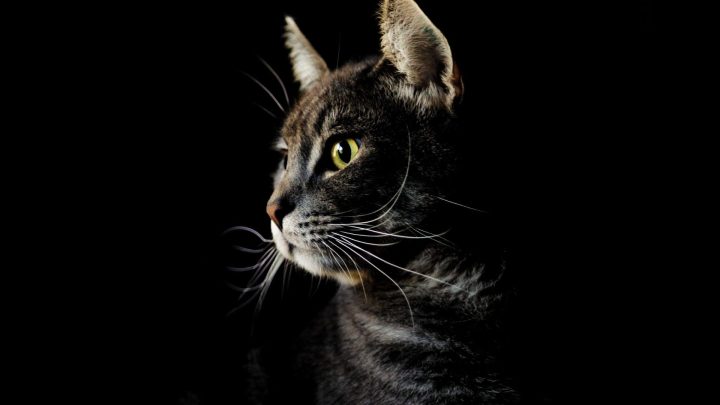
So, Can Cats See Ghosts?
Short answer: no scientific study has ever shown that cats see ghosts, and there’s no evidence that ghosts exist to be seen.
That said, your cat really does notice things you miss. Cats pick up faint movement in near darkness, hear sounds far above human range, and may even see some ultraviolet light. That hidden layer of the world explains nearly every “haunted” cat moment.
Why Do People Think Cats Can See Spirits?
The idea that cats have one paw in the spirit world is thousands of years old. It shows up across cultures, and each era added its own twist.
Ancient Egypt: cats as sacred guardians
Egyptians admired cats for their grace, stealth, and night vision, traits that helped turn them into sacred animals over time. The cat goddess Bastet was linked to protection, and some cats were believed to carry her presence inside them. According to the McClung Museum at the University of Tennessee, a cat became sacred only after special rituals, and huge numbers were mummified at Bubastis, Bastet’s cult center.
Medieval Europe: witches and familiars
Cats took a darker turn in medieval Europe. Black cats in particular got tied to witchcraft and were cast as “familiars,” helpers that could move between worlds. That reputation stuck around long after the witch trials ended.
Japan: shape-shifters and lucky charms
Japanese folklore swings both ways. The bakeneko e nekomata are supernatural cats said to gain magical powers with age. On the friendlier side, the beckoning maneki-neko figurine is a lucky charm you’ll spot in shops worldwide.
Why the belief sticks today
Modern cat owners aren’t reading ancient texts. The myth survives because everyday cat behavior looks eerie to us:
- Cats are busiest at dawn and dusk. They’re crepuscular, so peak activity lines up with spooky hours.
- They stare with total focus. A cat locked onto “nothing” looks like it knows something.
- Their eyes glow in the dark. That eyeshine comes from a reflective layer called the tapetum lucidum, not a spirit sense.
- Humans love patterns. We’re wired to find meaning, faces, and intent in random events.
- Viral videos. Clips of cats reacting to “empty” rooms rack up millions of views, and the ghost caption sells better than “probably a moth.”
What Can Cats Actually See That We Can’t?
Cat eyes are built for hunting small, quick prey in dim light. That design trades sharp daytime detail for strong low-light and motion skills. Here’s how a cat stacks up against you.
| Feature | Cat | Human |
|---|---|---|
| Field of view | About 200° | About 180° |
| Vision in dim light | Roughly 5.5 to 7 times better | Baseline |
| Rod cells (dim light and motion) | About 3 times more | Baseline |
| Sharpness (visual acuity) | Around 20/100 to 20/200 | 20/20 |
| Ultraviolet light | Lens lets some UVA through | Lens blocks it |
| Color | Muted, mostly blues and grays | Full color range |
| Total darkness | Can’t see | Can’t see |
(Sources: PetMD, Veterinary Information Network, News Tribune Ask the Vet, Douglas & Jeffery, 2014.)
Low-light vision
Veterinary ophthalmologist Paul Miller estimates cats see about 5.5 to 7 times better than humans in dim light. Their retinas are packed with rods, and a mirror-like layer behind the retina bounces light back for a second pass. So in a hallway that looks pitch black to you, your cat may clearly see a spider on the wall.
Motion detection
All those rods also make cats very good at spotting tiny movements, especially at the edges of their vision. A drifting dust speck, a fly near the ceiling, or a shadow shifting as a car passes outside can grab a cat’s full attention.
Ultraviolet light
This is the big one for ghost fans. In 2014, researchers Ronald Douglas and Glen Jeffery tested the lenses of 38 mammal species. They found that cats, dogs, hedgehogs, and ferrets have lenses that let significant UVA light through, which suggests these animals can detect some UV. Human lenses block it.
Why does that matter? Plenty of everyday stuff reflects UV, including some fabrics, urine trails, and certain cleaning residues. As Live Science reported, knowing that animals see what we can’t may help explain some of their odd behavior. A patch of wall that looks blank to you could look different to your cat.
Where cat vision falls short
Cats aren’t super-seers across the board. Their vision gets blurry with distance, color is dull, and veterinary sources note that the same features that boost night vision blur daytime detail. A cat “seeing a ghost” across a bright room is more likely seeing a fuzzy shape or a flicker of motion.
Super Ears, Sharp Nose, Sensitive Whiskers
Vision gets the spotlight, but hearing is probably behind most “ghost” stares. When your cat whips around to watch an empty corner, odds are she heard something first.
Hearing far beyond human range
A classic study in Hearing Research found that cats hear from 48 Hz up to 85 kHz, one of the widest ranges of any mammal. Humans top out around 20 kHz, according to PangoVet, while dogs reach about 44 kHz, per the Royal Canin Foundation.
That same source notes a healthy cat can pinpoint a sound’s location within about 3 inches from 3 feet away, using 32 muscles in each ear to swivel and aim.
Sounds your cat may hear that you can’t:
- Mice or insects moving inside walls
- High-pitched squeaks from rodents
- Electronics humming, chargers whining, and pipes ticking as they cool
- Footsteps or animals outside, long before they reach the door
A nose that reads the room
Cats also smell far more than we do, and they have an extra scent organ in the roof of the mouth called the vomeronasal (Jacobson’s) organ. That funny open-mouth face, called the Flehmen response, is your cat “tasting” a smell. A stray cat marking your porch or a new scent on your shoes can set off staring, hissing, or prowling.
Whiskers that feel the air
Whiskers sense tiny shifts in air currents. A draft from a vent or a door opening elsewhere in the house can make a cat suddenly alert, even when nothing visible changed.
Myth vs. Science: Decoding Your Cat’s “Ghost” Moments
Every spooky cat behavior has a far more ordinary explanation. Here’s a quick decoder for the most common ones.
| What your cat does | The spooky theory | The likely real cause |
|---|---|---|
| Stares at an empty corner | A spirit is standing there | An insect, a spider, or a sound inside the wall |
| Tracks “nothing” across the ceiling | A ghost floating by | A fly, drifting dust, or light reflecting off a phone or watch |
| Hisses at an empty doorway | An unwelcome presence | A strange scent, often another cat outside |
| Zoomies at 3 a.m. | Being chased by something | Pent-up energy during natural dawn and dusk activity |
| Yowls at night in an empty room | Talking to the dead | Hunger, boredom, or a health issue in older cats |
| Skin ripples, then bolts away | Something touched her | Possible feline hyperesthesia syndrome |
| Freezes and stares at a window | Seeing a figure outside | Birds, bats, or headlights you can’t spot from your angle |
Play paranormal detective
Next time your cat stares at “nothing,” try this:
- Get on her level. Crouch down to cat height and look from her angle.
- Kill the lights. Use a flashlight at a low angle to reveal dust, webs, or bugs.
- Listen closely. Put your ear near the wall or vent she’s watching.
- Check outside. Look for animals, lights, or movement through nearby windows.
- Sniff around. New smells near doors or vents often explain hissing.
- Note the timing. Repeated episodes at the same hour usually point to a routine cause, like a neighbor’s pet or a heating cycle.
When the “Ghost” Is Actually a Health Issue
Most staring is harmless. But some “haunted” behavior can point to a medical problem, especially in older cats. These are the big ones vets watch for.
Cognitive dysfunction in senior cats
Il Cornell Feline Health Center lists long periods of staring at walls or into space, confusion, and loud crying in the middle of the night as signs of cognitive dysfunction, a dementia-like condition that usually shows up after age 10. Penn Vet behaviorist Carlo Siracusa warns that these changes are not “just old age” and should be shared with your vet.
High blood pressure and hyperthyroidism
Cornell also notes that night-time yowling is fairly common in cats with hyperthyroidism or high blood pressure. High blood pressure can even cause sudden vision loss, which leaves a cat anxious and confused.
Feline hyperesthesia syndrome
If your cat’s back skin ripples and she suddenly bolts or attacks her tail, she may have feline hyperesthesia syndrome. It’s a poorly understood condition marked by extreme sensitivity along the back, and other causes like spine or skin problems need to be ruled out first.
Call your vet if you notice
- Staring spells that are new, frequent, or long
- Crying or yowling at night that wasn’t there before
- Bumping into furniture or missing jumps
- Pupils that stay wide in bright light
- Wandering, seeming lost, or skipping the litter box
- Rippling skin, tail chasing, or sudden panic when touched
So, Is Your House Haunted?
Probably not. But your cat lives in a richer sensory world than you do. She hears the mouse behind the drywall, spots the moth you missed, and may even catch a UV glint on the wall.
So the next time your cat locks eyes with an empty corner at midnight, grab a flashlight instead of a priest. More often than not, the “ghost” has six legs.
And if the staring comes with confusion, night crying, or other changes, skip the ghost hunt and book a vet visit. Your cat will thank you (probably by ignoring you, but still).
Domande frequenti
There’s no scientific evidence that they can. Cats do see and hear things humans can’t, like some ultraviolet light and sounds up to 85 kHz, which makes them look like they’re reacting to invisible beings.
Usually because she heard or saw something you missed: an insect, a mouse in the wall, a light reflection, or drifting dust. If the staring is new and happens a lot, especially in a senior cat, check with your vet.
No. Cats need at least a little light. They just need far less than we do, so a room that looks pitch black to you may be dim but usable for your cat.
There’s no evidence that either animal senses spirits. Both have UV-transmitting lenses and sharper hearing than humans, though cats hear higher pitches than dogs.
Common causes include hunger, boredom, wanting attention, or hearing outdoor animals. In older cats, night yowling can signal hyperthyroidism, high blood pressure, or cognitive dysfunction.
No. Coat color has nothing to do with a cat’s senses. The link between black cats and the supernatural comes from European folklore about witches.
There are touching stories, but no proven “death sense.” Cats are tuned in to changes in scent, routine, and household mood, which may explain why some seem to know when something is wrong.
Occasional staring is normal cat behavior. Worry only if it’s paired with confusion, vision problems, night crying, litter box changes, or twitchy skin.





 English (United States)
  English (UK)
  German
  Italian
  Spanish
  French