Noticing the symptoms of ailments affecting your dog can be tricky, even if it’s something as simple as a fever. If your dog has a high temperature, it’s usually just because they’ve been active. There are a number of other symptoms you might notice, though, if your dog does have a fever. But what are those symptoms, and what would cause a dog to get a fever in the first place? Read on for the answers to both of these questions and more.

Was verursacht, dass ein Hund Fieber bekommt?
Die meisten Fieber bei Hunden werden entweder durch eine Immun- oder eine Entzündungsreaktion verursacht. Was die genauen Ursachen betrifft, kann es unterschiedlich sein. Es kann sich um eine Infektion handeln, die auftreten kann, wenn ein Hund schädlichen Bakterien ausgesetzt ist.
Es gibt eine Reihe von Infektionen, die bei Hunden Fieber verursachen können: Ohr-Infektion, viral infections, UTIs, diseases borne from ticks, or infections of the dog’s internal organs.
Eine andere Ursache könnte sein neoplastisch, was zum Wachstum von bösartigen oder gutartigen Tumoren führen kann. Fieber ist ein häufiges Symptom von Krebs, insbesondere von Lymphomen oder Leukämie.
It could also be an immune mediated cause, which refers to when the dog’s immune system has become compromised, which would lead to an immune response.
There are a number of things that can indicate that a dog has a fever. In a moment we’ll break these down in detail.
But first…
Lernen Sie die normale Temperatur Ihres Hundes kennen
When you suspect that your dog has a fever, it’s going to be hard to make any conclusions from their temperature if you don’t know what their normal temperature is, when they’re healthy.
Die Normaltemperatur kann je nach Rasse unterschiedlich sein, die Durchschnittstemperatur liegt jedoch zwischen 100,4 und 102,5 Grad F.
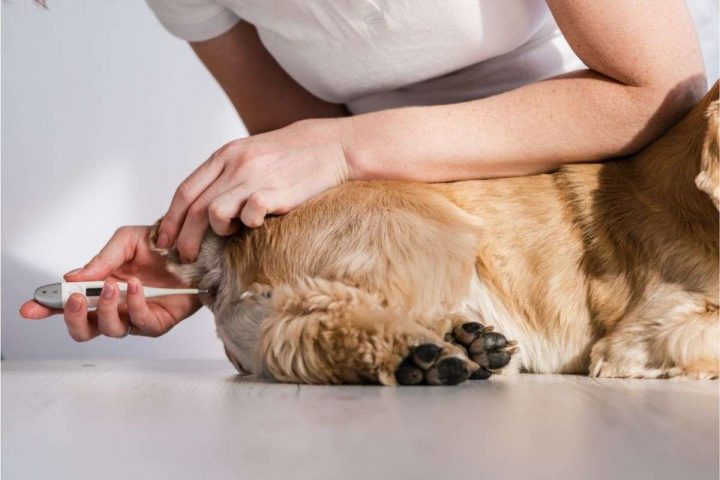
Also, wie findet man was heraus? dein dog’s normal temperature is? To do this, you’ll need to take their temperature with a rectal thermometer (when they’re feeling well, of course).

If you’d rather not, you can always just wait until your next routine checkup at the vet.
If you’re taking your dog’s temperature yourself, it’s important that you make sure they remain calm throughout the process. You can do this by feeding them treats throughout, or by having someone else gently hold them still.
- As we said, you’re going to need to use a rectal thermometer, so you must first make sure that it’s properly lubricated with lubrication gel or lubrication jelly.
- When you’re sure your dog is calm, lift up their tail gently (if it’s that kind of tail) and locate the rectum, which will be just under the dog’s tail.
- Führen Sie das geschmierte Thermometer bis zur metallbeschichteten Spitze ein. An diesem Punkt können Sie das Heck absenken.
- Schalten Sie Ihr Thermometer ein und warten Sie etwa 10 bis 30 Sekunden, bis das Thermometer einen Messwert anzeigt. Nehmen Sie dann das Thermometer vorsichtig heraus und reinigen Sie es.
If you later suspect your dog of having a fever, you’ll be able to take their temperature in the same way, and compare this temperature to their normal temperature.
It’s worth noting that the temperature of your dog will vary throughout any given day. For example, they’ll tend to go up a little during the night.
It can also be beneficial to keep track of your dog’s normal respiratory rate, pulse, and capillary refill time. Having all this information on hand should make it easier to detect when your dog is unwell.
So erkennen Sie, ob Ihr Hund Fieber hat: Symptome
Hohe Temperatur
Das Temperatur, die bei Hunden häufig auf Fieber hinweist is at least 103 degrees Fahrenheit. If you don’t have a rectal thermometer, there are other ways to find out the temperature of your dog.
While they won’t be as accurate as knowing the exact temperature, they should still give you a good indication of a fever.
You can take your dog’s temperature by feeling their ears and their paws. Normally, a dog’s ears and paws should feel just a little warmer than your hands.
Wenn sie sich mehr als nur geringfügig wärmer anfühlen, hat Ihr Hund möglicherweise Fieber.
You can also check the dog’s nose for signs of green or yellow discharge.
This can be a symptom of an infection, which would also be causing the dog’s fever. Get in touch with a vet as soon as you can if you suspect that your dog has an infection.
The dog’s gums can also be an indicator of a fever. If your dog is sufficiently calm, open their mouth gently with two hands.
If their gums look dry or feel warm, and if they’re redder than they usually look, it may mean your dog has a fever.
The final way you can check your dog’s temperature without using a rectal thermometer is by checking their groin and their armpits.
Legen Sie Ihren Hund auf den Rücken und betasten Sie sanft seine Leistengegend und seine Achselhöhlen. Fühlen sie sich heiß, geschwollen oder beides, ist dies ebenfalls ein Symptom für Fieber.
Andere Symptome
If a dog has a fever, it’s common for them to exhibit symptoms like panting, lethargy, or shivering. Often fevers are caused illnesses, in which case your dog may also be experiencing coughing, diarrhea, or vomiting.
You might also notice that they’re drinking more than they usually do – but even dogs with fevers essen ihr Essen oft so, wie sie es normalerweise tun würden.
Fazit: So erkennen Sie, ob ein Hund Fieber hat
Der beste Weg, um festzustellen, ob Ihr Hund Fieber hat oder nicht, ist die Temperaturmessung. Dies kann mit einem Rektalthermometer oder durch die Kontrolle von Nase, Mund, Leistengegend und Achselhöhlen sowie Ohren und Pfoten erfolgen.
Weitere Symptome sind Hecheln, Lethargie und Frösteln. Wenn Ihr Hund krankheitsbedingt Fieber hat, kann es auch zu Durchfall, Erbrechen und Husten kommen.
If you do suspect your dog of having a fever, consult with a vet immediately. There’s no reason to be worried, but it could be a sign of a number of illnesses.
Häufig gestellte Fragen
Ohren und Nase eines Hundes sind oft gute Indikatoren für die Körpertemperatur. Wenn sie sich wärmer als gewöhnlich anfühlen, könnte das auf Fieber hindeuten. : Auch die Bauch- und Pfotenballen können Hinweise auf die Körpertemperatur geben. Wenn sie sich übermäßig warm oder heiß anfühlen, könnte das ein Zeichen von Fieber sein. Das Fühlen der Körpertemperatur Ihres Hundes mit der Hand kann Ihnen einen allgemeinen Überblick verschaffen. Es ist jedoch wichtig zu beachten, dass die Temperatur eines Hundes am genauesten mit einem speziell für Haustiere entwickelten Rektalthermometer ermittelt werden kann.
Zusammenhängende Posts:
 Dürfen Hunde Edamame essen? Sind Edamame-Bohnen für Hunde sicher? - Antwortete
 Kann ich meinem Hund Calpol geben? Ist Calpol sicher für Hunde und Katzen?
 Warum frisst mein Hund nicht, sondern trinkt Wasser?
 Was tun, wenn der Nagel Ihres Hundes abgerissen ist?
 Dürfen Hunde Oliven essen? Ist es sicher für Hunde, Oliven zu essen?
 English (United States)
  English (UK)
  German
  Italian
  Spanish
  French